By Nana H.
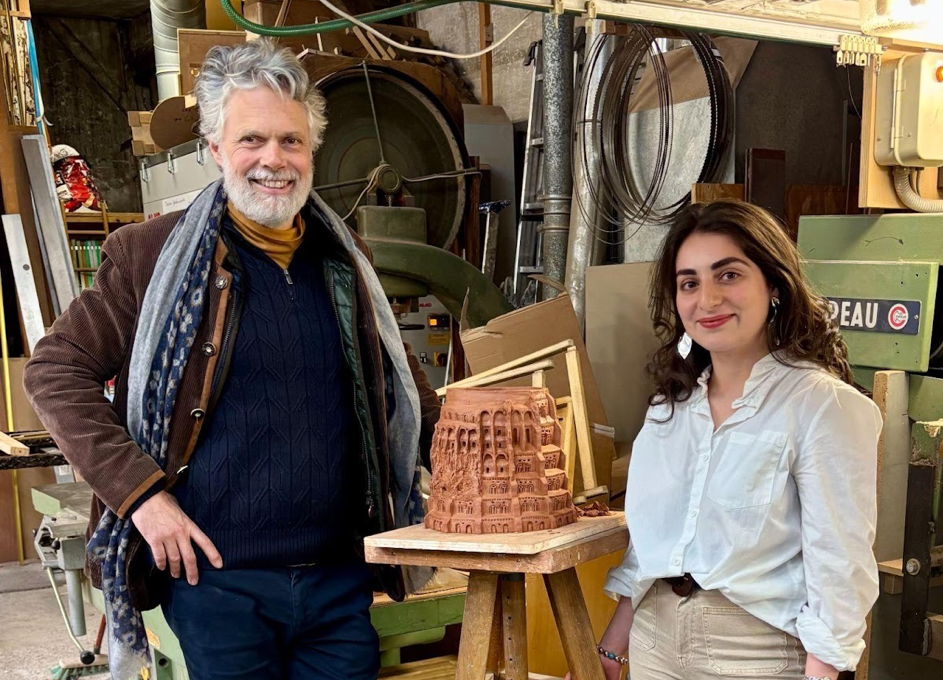
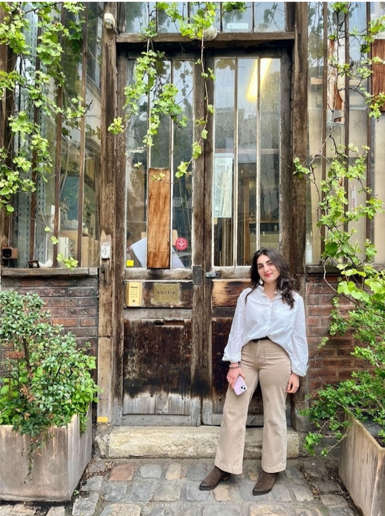
I walk through the narrow, lively streets of Bastille, hearing chatter from full café terraces. I turn right, passing a small independent bookstore, onto the historic Rue de la Roquette, long known for the presence of its workshops. A marvelous sight appears: neo-Gothic wooden walls lined with a series of large windows, draped in vines and early spring cherry blossoms in the Paris afternoon sun. I step forward and gently push the door; the playful tinkle of a small bell above announces my arrival into Kostia’s atelier.
Kostia is an art and design studio founded in Paris in 2012 by Constantin Laan ’97, who named it in honor of the nickname his Russian grandfather had given him as a child. Inside, the atelier feels like a microcosm of the outside, made more enchanting by the its artist-cabinetmakers’ delightful creations. Delicate sketches of cherry blossoms on the door, variations of gold leaf applied to furniture surfaces, and a wine-red box freshly covered in overlapping scale motifs awaiting transport to the Petit Palais for an upcoming exhibition.
If I were to sum up the lessons of a brief liberal arts séjour, “say yes and find your way along the journey” would be a fitting motto in the endless pursuit of “knowing thyself.” Interning at Kostia certainly belongs in this category. Creations of furniture, functional art objects, and lighting evoke a forest of symbols and seasons, an ideal setting for my semester with Hamilton in France.
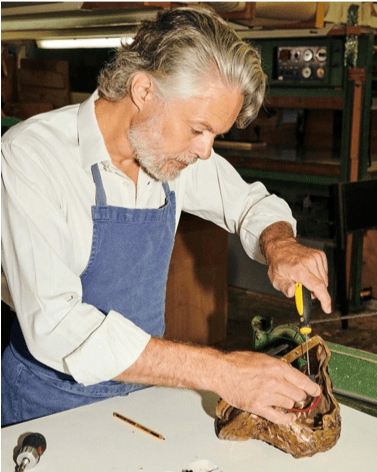
Born and raised in France, Constantin found the traditional French baccalauréat unfitting and considers himself fortunate to have discovered Hamilton College. He studied a broad range of subjects spanning languages, the arts, and the social sciences. “A liberal arts education teaches you how to think and how to adapt,” he notes.
Having built the early foundations of a career in international economics and media, Constantin came to feel he was “thinking too much and not doing enough,” where doing points to the act of gesture, of working with one’s hands. After an intensive training of about a year he learned the craft of ébénisterie, or woodworking.
“You always have the question, ‘Will I be good enough?’ – and I seized the chance when it presented itself,” he recalls. From inspiration to sketches, to drawings, to functional sculpture, Kostia is an art studio with its own production capacity. Today, it creates pieces that are sustainable in concept, quality, and materiality – a vision of timelessness, imagining the “antiques of tomorrow,” housed in the eponymous gallery in the sixth arrondissement.
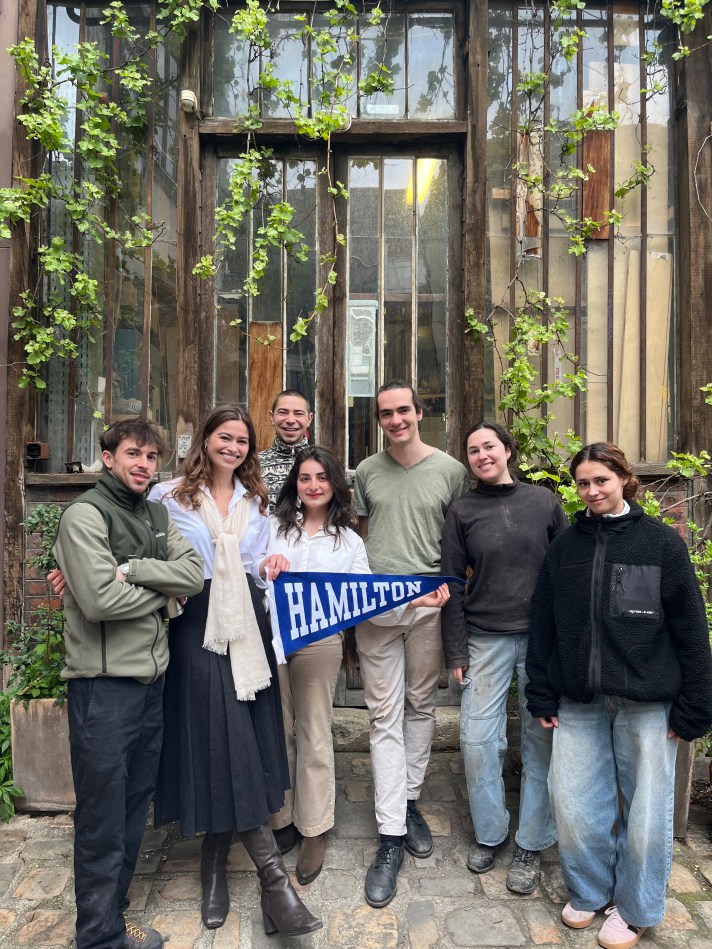
Eliza Pendergast ’24 assists in U.S. client relations as part of Kostia’s efforts to expand internationally. An art concentrator at Hamilton, and now a student at Parsons School of Design in Paris, Eliza generously welcomed me into the atelier, and spoke with care about each creation. Near the fireplace, the team gathers for lunch every day – in a spirit where creativity finds multiple expressions – sharing meals cooked by the ébénistes themselves. “People are what make Kostia unique,” Eliza tells me. I could not agree more.
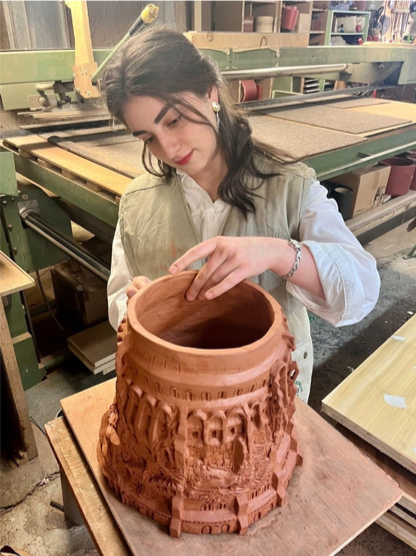
Soon after, Constantin designed a project for me, which became the magnum opus of my internship: to build a Bruegel-inspired Tower of Babel in clay, ultimately to be 3D-scanned as a model for a table leg. “It is interesting that an Armenian builds a Tower of Babel,” one of our visitors remarked one day at the lunch table, alluding to the biblical story of Noah on the summit of Mount Ararat, when the waters had receded. Structurally challenging, the piece stretched my artistic capabilities, in what felt like hand learning, after previous internships in economics-related fields focused on other faculties.
“How to build, technically, is always a question. We try to think like engineers. A liberal arts education allows you to think, to test knowledge, and then to make your own path; in a certain way, you become your own liberal arts college,” Constantin notes, citing a phrase he read in a recent journal: “I invite you into my world – there are already many of me there. On s’amuse beaucoup!
“I wanted to do it the American way,” he tells me with a smile, gently petting his pug, Panda, a lovable member of the studio.. “And the French way,” I respond. The Hamilton way is implied by both – nonconforming, ever-changing, and evolving, driven by a desire to discover one’s talents fully, without limitations. And, it carries a spirit passed across generations of Hamiltonians: with every step forward, extending a hand to the next person in line, whether in New York offices or hidden Parisian art studios.

