By Juno P.
Choral singing entered my life when I was a freshman. Though I had sung casually before, in college, I fell suddenly and utterly in love with making music by combining my voice with others: the vibrations of a perfectly balanced chord, just as much as the way the choir became a second family. In fact, leaving it behind was one of the most significant considerations against studying abroad, and, having ultimately decided that a semester in Paris was too good to give up, I soon began searching for a surrogate choir.
The first thing that a liberal-arts college student will note is that Paris—despite being a global beacon of art—does not have a culture of student acapella groups. The choir clubs at Paris Cité and Sorbonne Nouvelle (the two universities at which Hamilton in France (HiF) students most commonly enroll) were unimpressive, and I was hard pressed to find any outside the universities (an exception, Chœur Ephata, looked great, but didn’t work for me as it required at least a year’s commitment). Amateur choral singers in Paris, it turns out, are mostly to be found in church choirs. This might be a non-starter for those who, for reasons of faith, have no interest in attending Catholic mass every Sunday. But, while there’s no two ways about the fact that church choirs sing religious music at religious services in a community of religious believers, my experience with the choir Laudamus Te showed me that joining a church choir could be an experience that wasn’t a test of my devoutness (I don’t regularly attend mass at college), but one that was welcoming social and musical experience.
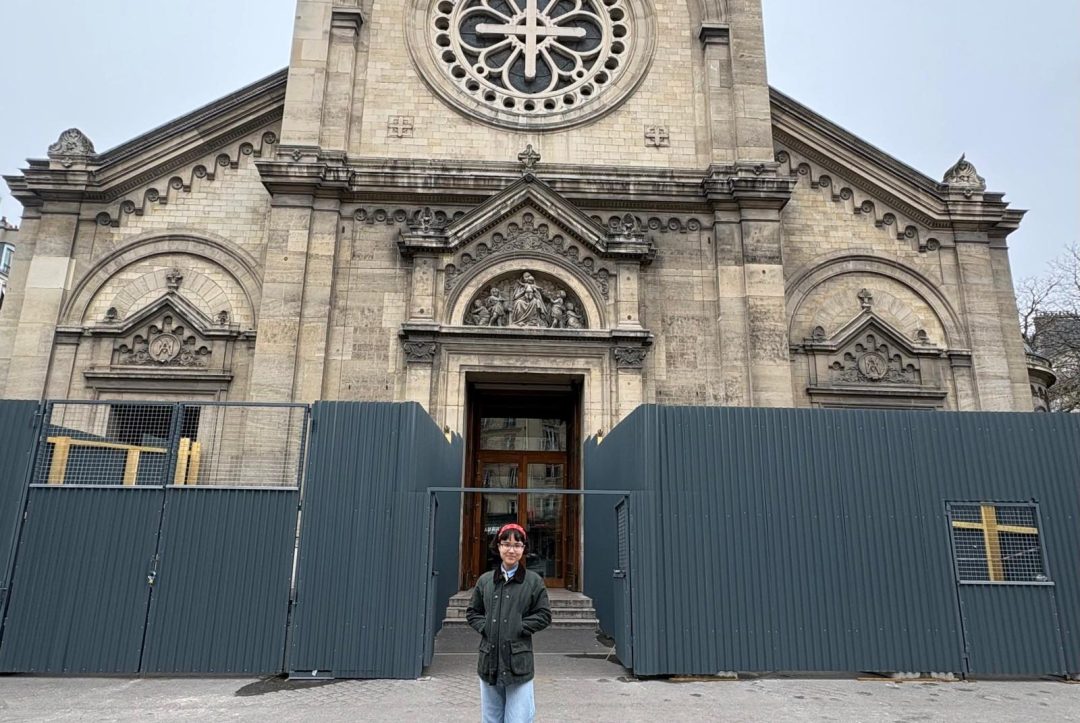
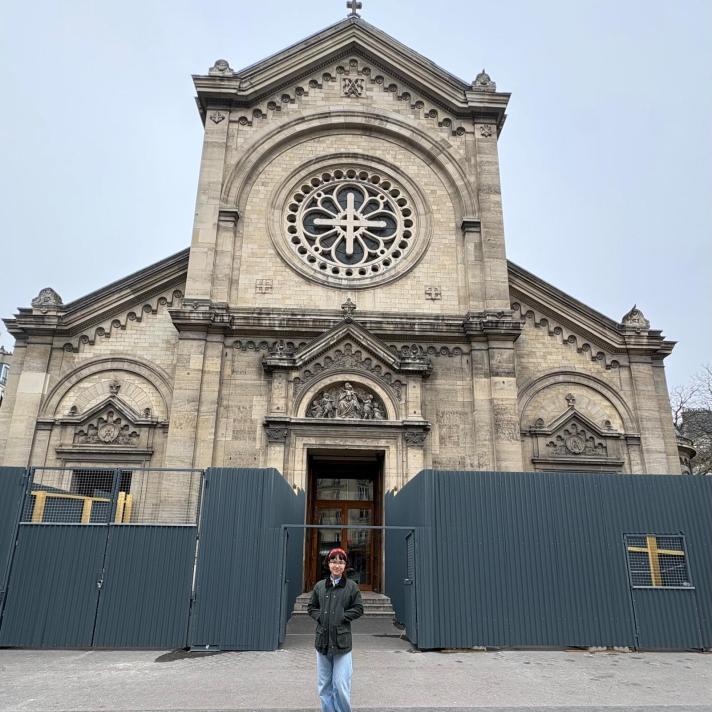
Notre-Dame-des-champs, where Laudamus Te “animates” Sunday mass (the French verb “animer” means to lead or to host, but I love the sense of warmth and vibrance the word suggests in English), was built in 1858 just as the neighborhood was being Haussmannized, the fields after which it was named replaced by the iconic terrassed houses. The parish, however, can continuously trace its history to Roman times before Christianity had even arrived in the region. The parish’s church—which the current building replaced—was built on the vestiges of a Roman temple dedicated to the deity Mercury later rededicated to the virgin Mary. That is all to say that, in addition to singing and good company, singing in a choir like Laudamus Te is also a way to experience the seemingly bottomless history of Paris.
The choir is mostly composed of young professionals—lawyers, teachers, engineers—with a smattering of graduate students. I’m the youngest, but not by much. We rehearse for an hour and change in the crypt of the church (not a cathedral, as Gaspard, one of the tenors, gently corrected me). The atmosphere is convivial but focused. As is typical in church-affiliated singing, we go through material very quickly, learning an introit, the latin mass (Kyrie, Gloria, Alleluia, Sanctus, and Agnus Dei), a psalm, communion anthem, and recessional on the spot. Our singing during in the cavernous main sanctuary (whose pews fill up every week without fail) is not flawless, but harmonically sound and always musically expressive.
I was getting ready to leave the first Sunday, I was invited to join the rest of the choir for a drink. At a pub across the street, I was, as a member of the choir, greeted with a familiar «comment ça va?» by the waiters before being led to a long table saved for us upstairs. This post-mass dinner soon became a part of my weekly routine. At first, I spent most of my time trying to comprehend what was being said in the conversation around me, but soon found that I was able to make more interesting contributions to the conversation than I thought.
Once, early on, I found myself caught in the crosshairs of a dispute between Gustav and Laure about the portrayal of the macabre in French literature. Finding a brief pause, I asked which French novel they thought I should start with. Before I knew it, they were heatedly discussing which book to recommend. Gustav advocated Maupassant, while Laure leaned towards Hugo. Later in the week, I bought a copy of «Boule de Suif» by Maupassant at the neighborhood bookstore—much to the chagrin of the Laure who I told the following Sunday.
What started off as a search to find a way to satisfy my yen to sing has become an introduction into a warm community, a way to take part in quotidian Parisian life, and rigorous training in French conversation. My advice to future Hamilton in France students? Find communities that are rooted in Parisian life. Invite yourself there. Don’t worry about feeling out of place or not being able to make conversation. If you like the people, keep going back. Making Parisian friends and learning French are both activities that take resilience and time.
 Hamilton in France